Arcades Everywhere
Description
For this project, your aim is to create a work of interactive media art that is designed to be played in public. This project may take many forms, from a work that may embarrass players/onlookers, a work that will inspire cheer and applause, and further.
Your project should be designed for a particular public. Perhaps it is designed to be played by a campus group you are involved with. Perhaps it is designed for a particular location. For whom are you designing? Additionally, you should consider the values you project is communicated through both its design and mechanics.
Considering the games discussed during this unit, your project should be simple to understand, easy to begin playing, and if you choose, difficult to advance after a certain point. Of course, these parameters can be tweaked and altered depending on the publics you have in mind. Your final submission will include a work of interactive media that will be played and critiqued and class, as well as a piece of writing that situates your work within the class readings.
Framing
While it might seem that games played in public disappeared with the Arcade, public forms of gameplay still exist within contemporary culture.
Mobile
Perhaps public play just became synonymous with smart phones; an act of public computing many of us constantly experience. If you own an iPhone you might even note that Apple’s game subscription service is called Apple Arcade. People are playing games everywhere: in parks, on trains, in class, or waiting in line. While these mobile games might not look visually similar to the games of early arcades (See: Love in Deep Space), many of these games include similar tactics of getting players into a flow state to continually extract value. While not true of all mobile games, many of these games focus on a small definable loop that can be played endlessly for high scores (See Candy Crush Saga, Subway Surfers, Fruit Ninja, Clash of Clans, Flappy Bird). At the same time, artists like Zach Gage are exploring the limits of the casual game space as an attempt to see if interesting work can be made when we focus on quick yet complex interactions.
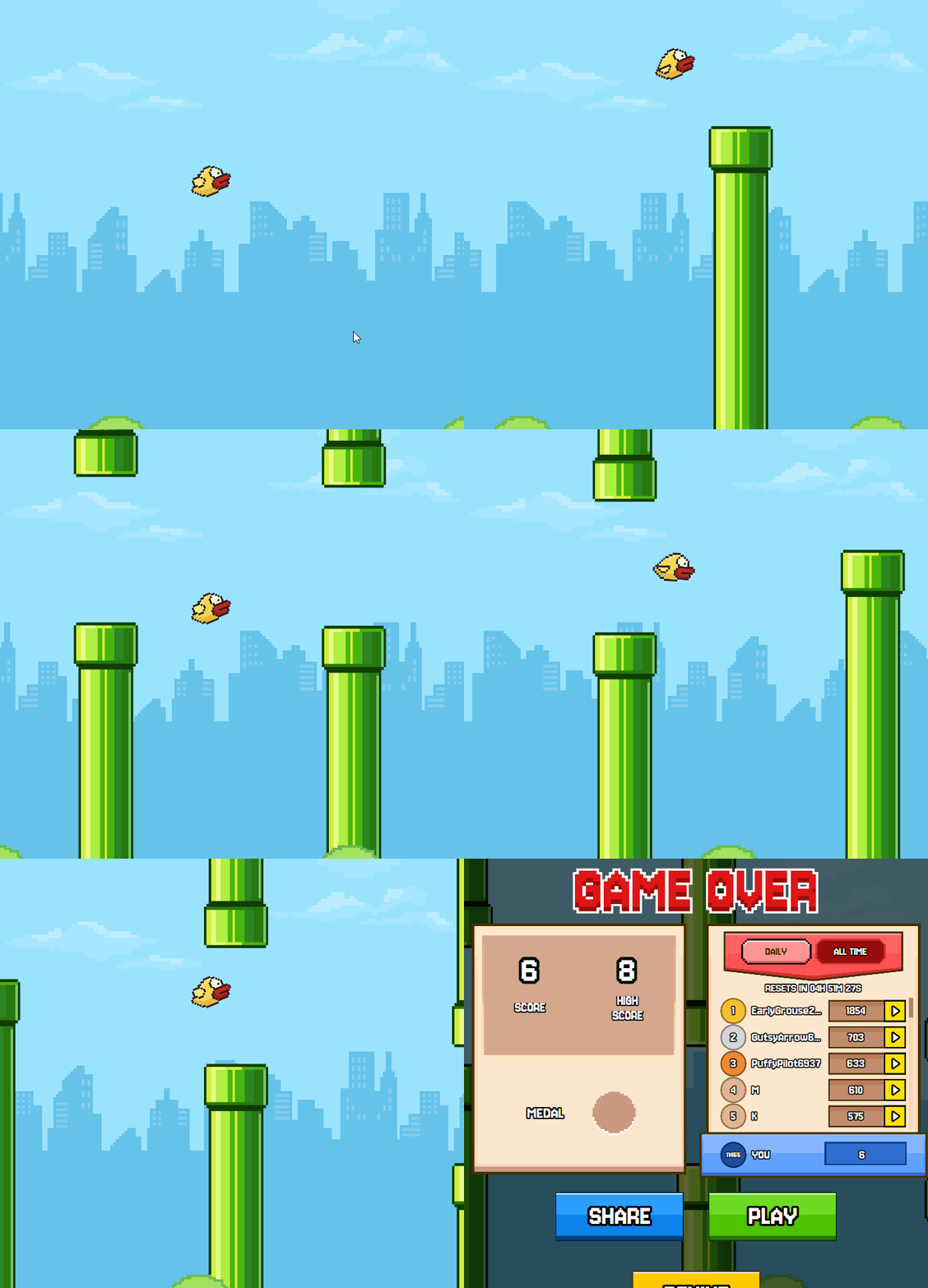
Flappy Bird by Dong Nguyen
Galleries
Games in public can now also be seen widely within art galleries. From the works of Danielle Brathwaite-Shirley, Alex Mackin Dolan, to Lawrence Lek, artists are exploring the aesthetics of games and interactive media to think through a variety of cultural, political and economic ideas.
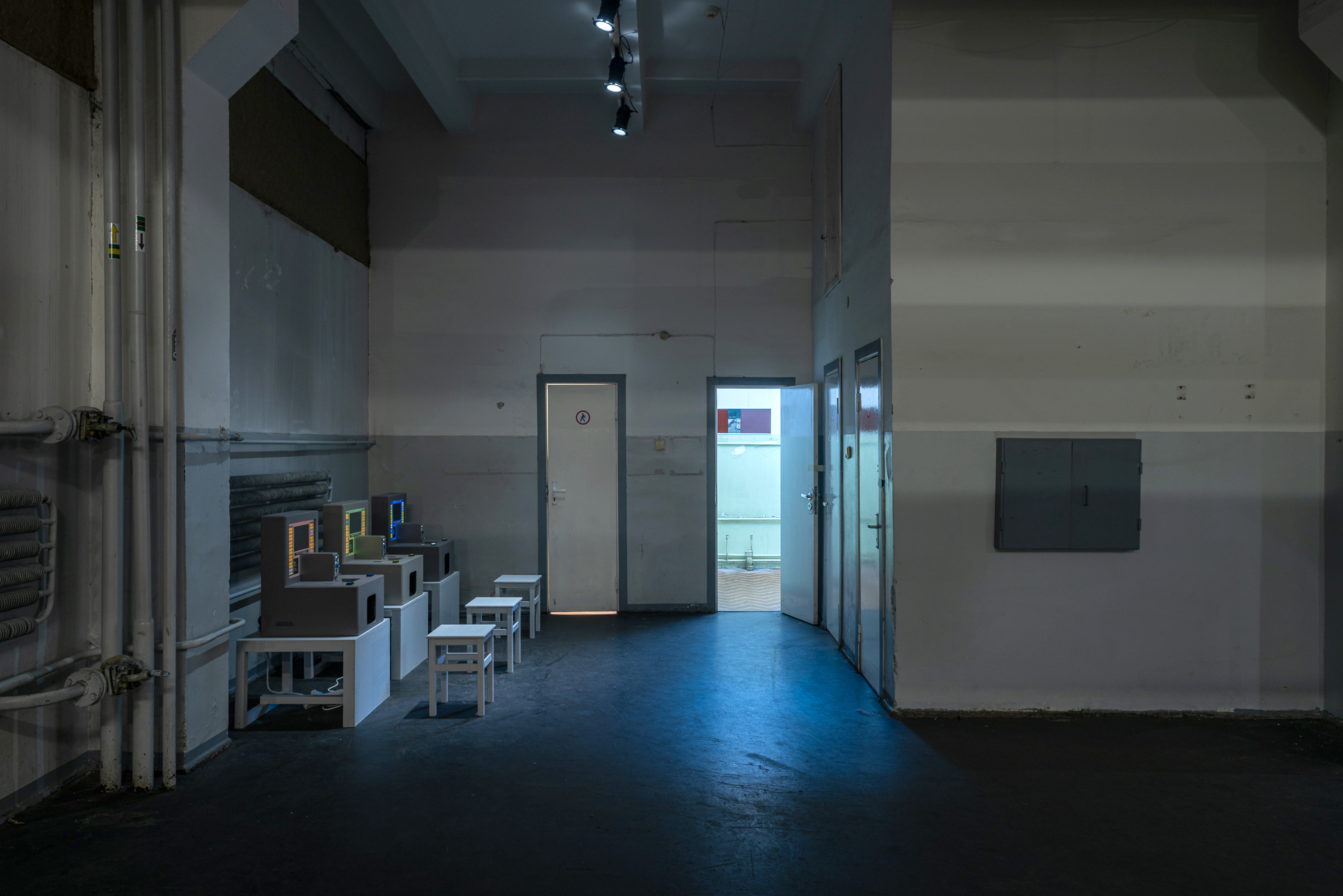
Alex Mackin Dolan, Untitled (Brain Nourishment Version Two), 2024-2025, Computer components, paint, wood
New Arcades
Aside from art galleries, independent game makers are still continuing to produce arcades and arcade cabinets. Oftentimes less focused on conceptual and aesthetic questions and more focused on game play, these arcade games are continuing to push the bounds of public play. A variety of these arcade games can be found at independent arcade venues such as Wonderville in NYC. One notable public independent project is the arcade cabinet Nave by Videogamo, a traveling arcade cabinet that maintains high sorces across locations. Notably academic explorations of public game play include UCLA’s Game Art Festival and NYU’s No Quarter Exhibitions.
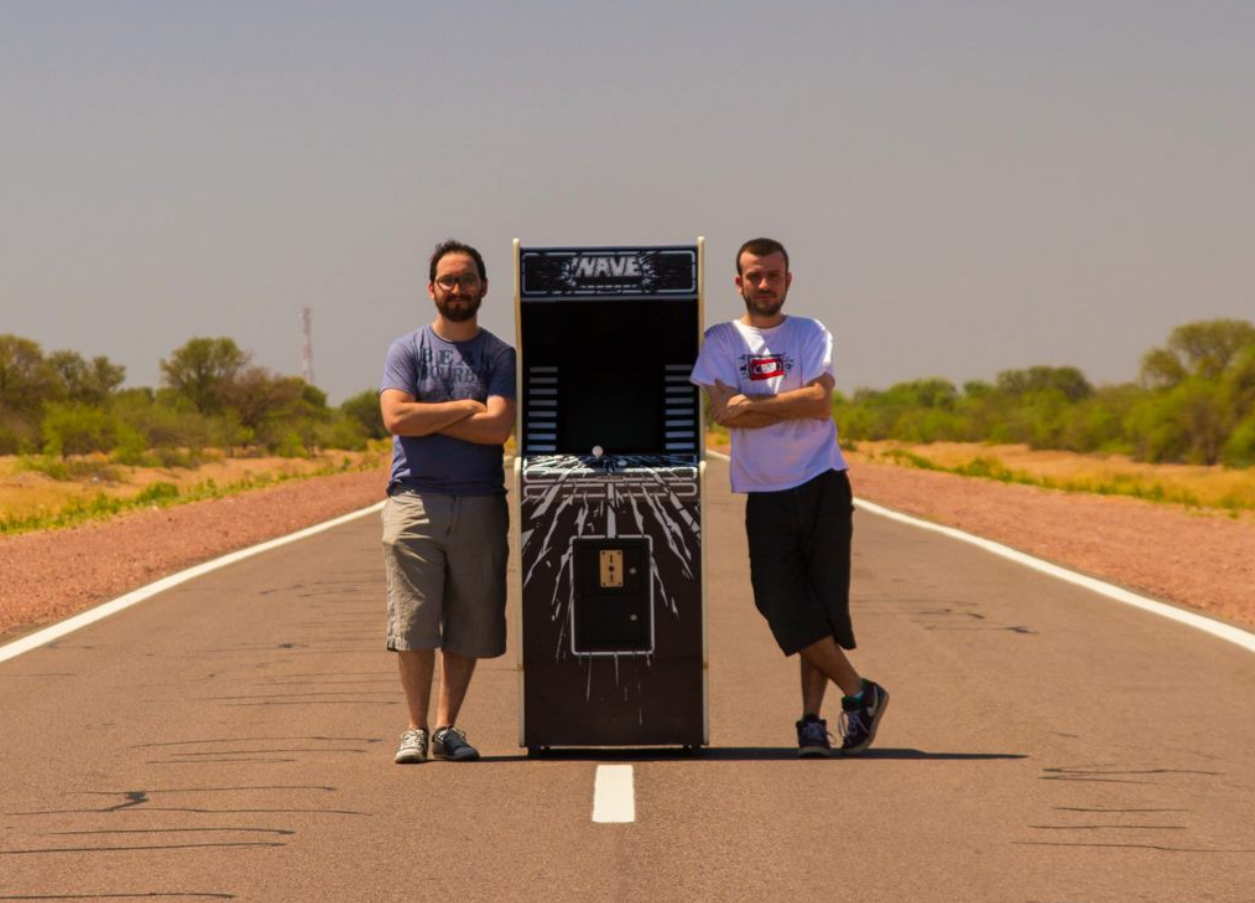
Nave arcade Cabinet by Videogamo
“NAVE is a traveling videogame. What exactly is that? In 2010, we started to program NAVE as a computer game, but then we realized that the game was meant to be played on a videogame arcade machine, like those from the 70’s, 80’s and 90’s.”
Streaming
Additionally, as T. L. Taylor notes in her book Watch Me Play: Twitch and the Rise of Game Live Streaming, games are being played in online publics for millions of viewers. Many game developers also note having this form of public in mind when making a game. A common adage in game development is that games that get picked up by streamers sell. We see this effect with games such as Goat Simulator, Getting Over It with Bennet Foddy, Among Us, Phasmophobia, Lethal Company, and Meccha Chameleon. Consider what about these games makes them compelling for both audiences to watch and streamers to play.
Project Components
| Component | Points |
|---|---|
| Close Play and Journal | 3 |
| Proposal | 1 |
| Prototype | 2 |
| Writing | 4 |
| Game | 15 |
| Total | 25 |
Readings and Media
As part of this project, you will engage with a variety of media throughout this unit. Students should engage with the media for this unit when assigned to stay on schedule. Your writing for this project will ask you to reference all of the unit materials.
During this unit we will be engaging with the following texts:
- Anthropy, A., Clark. N. (2014). A Game Design Vocabulary : Exploring the foundational principles behind good game design.
- Good Clean Fun from Newman. Z., M. (2017). Atari Age
- Woodhouse, N., T. (2025). Feeding the Iron Pimps: The Golden Age of Arcades in Black America. Game Studies, *25(3).
- Kocurek. A., C. (2012). The Agony and the Exidy: A History of Video Game Violence and the Legacy of Death Race. Game Studies, 12(1).
- Bogost. I., Montfort. N. (2009) Random and raster: Display technologies and the development of videogames. IEEE Annals of the History of Computing, 31(3), 34-43.
We will play the following games:
- Asteroids
- Arcade Games at Lost Levels
Close Play and Journal
In addition to assigned readings and media, students must complete a close play of two games during this unit. Students should play each of their chosen game for 1 hour each. Critically playing for a longer period of time is strongly encouraged. It is recommended that students browse through the list of games and look up a trailer or long play of each game before making a decision on what games to play. Students are also encourage to play more than two games on the list.
Student should approach their play using a close play methodology outlined in this article by Edmond Y. Chang.
The below selection of games is a curated list of contemporary independent video games that embody many of the design principles of arcade games or games played in public. All of these games are relatively easy to learn, can be picked up at anytime, for any duration, and are difficult to become experts in. Some of these games such as Hades, Neon White and Celeste are connected to a larger story, however, they still contain an addictive and twitchy game loop that keeps them hooked. These games were chosen not necessarily because they are played in public, but because most of them contain simple and refined game loops that work well in public or streamed settings.
All of these games are either available through Steam or Itch on the class computers. While students may play these games on their own devices, it is encourage that the class finds a shared time to meet within the lab to play these games together.
As part of the close play assignment for this project, you will also be submitting a game journal. Your game journal should be around 200 words per game and should informally respond to the games based on the topics and ideas we are covering in class.
You may find the following prompts helpful as you write each journal entry (From The Well-Read Game: On Playing Thoughtfully, Fullerton & Farber, 2025)
-
Describe your experiences in the game as if you are describing a dream or travel to a new place. (Use the first person, present tense.)
-
How does the game begin — Where are you? Who are you playing? What do you want or need to do? As the game unfolds, what happens that moves you? Do you relate to any characters or situations? What do you bring to the game from your own lived experiences?
-
Are there peak moments of play that make you want to capture them as screenshots or to remember
List of Games
- Vampire Survivors (Itch or Steam)
- Nidhogg (Steam)
- Hyper Demon (Steam)
- Downwell (Steam)
- Flappy Bird (Online)
- Getting Over It (Steam)
- Neon White (Steam)
- Celeste (Steam, Itch)
- Hades (Steam)
- Balatro (Steam)
Submit
Submit your journal to Canvas.
Proposal
Within your proposal answer the following questions. Bring a printed copy of your proposal to class to discuss with the instructor.
- What is the working title of your project?
- In one paragraph, describe the experience of your project.
- If there is a goal, What is the goal of your interactive project?
- What are the audience’s actions within your project?
- What is the concept of your project and how will it relate to the interactions?
- How do you imagine the project will make audiences feel?
- What public are you designing your project for?
- What is your plan for programming the project? Will you need to learn additional skills? What is your timeline between now and the due date of the project?
Rubric
1: The student answered all questions and clearly articulated the design intentions of their project.
0-1: The student answered some to all questions and mostly articulated the design intentions of their project.
Submit
Submit your proposal to Canvas.
Prototype
Submit a prototype that includes all the major interactions your project will include. Your project does not need to include your final art assets. This should be a gray box prototype; meaning, similar to when we were building our our asteroids project before the final art, your project should include your most difficult programmed systems. As the point of your prototype is to get feedback on your in-progress project, you should have enough of your project complete to be able to get peer and instructor feedback. Your project must be playable on the due date of the prototype. Students should prepare questions for peer and instructor feedback on their prototype.
2: The student’s prototype is playable and conveys the main ideas of the project. Peers and the instructor are able to provide feedback based on the level of completeness of the prototype. The student is prepare with questions to ask about their project.
1: The student’s prototype is playable, however, the project is completed to such a degree that it is difficult to understand the student’s intentions. As a result, peers ant the instructor may have difficulty providing feedback on the project.
0: The student’s prototype is non-functional or is incomplete
Submit
Bring your playable prototype to class and have it set up for students and the instructor to engage with.
Writing
Each student should submit a 600 to 1000 response to canvas that address the following questions. Answer will be grading
- How did Newman and Woodhouse readings on gaming publics inform your decision on what public you wanted to design your game for?
- How did the class visit to Lost Levels inform your project?
- How did the Kocurek reading inform the type of values you wanted your game to communicate?
- Considering the Bogost and Montfort reading, how did the technology of the Unity Engine impact the type of project your ended up designing?
Submit
This writing should be submitted to Canvas.
Rubric
4: The students response demonstrates deep engagement will all the assigned media. The student is able to cite the provided sources and use the sources to demonstrate decisions about their project.
3: Most of the students responses demonstrate engagement with the assigned media. The student demonstrates the ways in which the assigned media informed their project.
0-2: The response not demonstrates the student did not fully engaged with all the assigned material.
Final Game
The submission for your final game should include:
An itch.io page that includes:
- A zipped Windows build of your project
- 3 screen shots of your project
- The title of your project
- A short paragraph description with controls information
The itch.io page should be submitted to both Canvas and the class Discord
The final game will be graded using the following rubric.
Project with incomplete materials listed above will lose points for based on the amount of items missing.
Final Rubric
Check List (points lost for missing items)
- Customized itch.io page
- A zipped Windows build of your project
- 3 screen shots of your project
- Title of your project
- A short paragraph description with controls information
- Itch.io page submitted to Canvas
Concept (5 points)
4-5: The student went above expectation in their conceptual approach to the project. The relationship between public spaces and interactivity thoughtfully considered in the work. The student approached the concept for the project with creative/intellectual generosity and was able to demonstrate conceptual risk-taking in their project.
3-4: The student met expectation in their conceptual approach to the project. The student presented a thoughtful interpretation of the project prompt and explored the relationship between public space and interactivity.
0-2: The student did not meet expectation in their conceptual approach to the project. The student did not demonstrate an understanding of the assignment. The assignment might be missing required elements or shows little effort to consider the project prompt.
Code (5 points)
4-5: Within the project, the student used their programming knowledge to to create a conceptually and technically complex system. The student made use of materials learned in class as well as explored new approaches to using Unity. The student is able to clearly communicate their system and the programming concepts they used to design their project. The program is full functional.
3-4: Within the project the student used their programming knowledge to to create a functional system. The student(s) only made use of functions learned in class. The student can communicate their system and the programming concepts that used to design their project. The program contains some bugs but is functional.
0-2: The student(s)’ project is either non-functional or barely functional. While effort was made to create the project, the final code contains bugs or errors that causes the program to be unable to run. The student(s) did not seek help from the instructor or peers in advance of submission. The program may not be functional.
Craft (5 points)
4-5: The student(s) demonstrated exceptional thoughtfulness and intentionality in their visual, text, audio, and interactive design. Visual, text, audio, and interactive elements of the project are clearly connected with the student(s) conceptual approach.
3-4: The visual, text, audio, and interactive elements of the project is somewhat intentional and can be connected to the conceptual approach to the project.
0-2: The visual, text, and interactive elements of the project are unrelated to the conceptual approach to the project.